

Shenandoah SOundcheck
Rebecca Porter: Making Her Own Table in Country Music
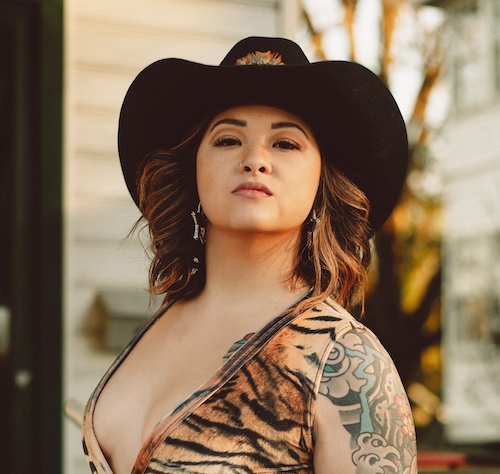
“My goal [as] a music is I dont want anyone to feel like they are not welcome at my show.”
By Jake Dodohara, October 20th, 2023
Residing within the Shenandoah Valley’s Harrisonburg, Rebecca Porter is a captivating singer-songwriter, known affectionately as the “sad girl of country music.” Her music has earned her a distinct place in Shenandoah’s country and Americana music scene and Shenandoah Soundcheck had the privilege of delving into the enigmatic world of Rebecca’s creative identity and music. Join us in this exclusive interview as we peel back the layers of Rebecca Porter’s artistic journey, from her unique songwriting process to the intricacies of recording, and the Valley’s impact on her musical output.
If you were speaking to a stranger on the street, how would you describe your creative identity and your music?
I would say I’m a singer-songwriter who writes music in the country and Americana realm. I’m often referred to as the “sad girl of country music” as a joke, but I write from an authentic and real place. Music as a personal outlet for working through tough parts of life as well as the celebrations.
What is your songwriting process like, and where do you draw inspiration from?
I don’t have formal training in songwriting, but I’ve been writing poetry since I was in seventh grade. My songwriting process usually starts with words and a melody, as singing is my strong suit. I record my ideas or save them in my phone’s notes and revisit them later. I don’t have a strict routine but try to keep songwriting a regular part of my creative process.
How has the recording process been for your songs, and what’s it like working through mixing and mastering?
I had some recording experience from past bands, but I wasn’t directly involved in decision-making. When I started recording my solo EP, I worked with someone but felt unable to express my opinions. Eventually, my collaborator had life changes and couldn’t commit, which was a relief. I then found Jacob Briggs, who recorded and engineered my work. Jacob was great at making me feel comfortable, discussing project plans, and ensuring my voice was heard throughout the process.
When did you first arrive in the Shenandoah Valley and how has the valley’s community affected your work?
Where I grew up, it was very much like you go to church on Sundays. Everybody votes this way. A lot of very good people. As well as a lot of people with very good intentions that may not know the best route to take to get to certain places.
My mother is white, and she has fair skin and red hair. I’m basically like my father’s twin [who is of Pacific Islander heritage.] To be in the valley, where I physically look so different from everyone around me and then having like my metaphorical lifeline who I identified with move away was a very isolating experience. I had friends when I was growing up you know, like people didn’t show me I have friends growing up with but there were a lot of microaggressions. I would be treated differently and not really understand why.
My experience [has informed my] storytelling, my voice as a singer songwriter, as a woman of color Throughout being in a cover band and [I was] tokenized as a person of color. It was a band with all dudes but they weren’t making a lot of traction. And so they bring this woman on to the scene to make them more relatable.
As far as country and Americana music I’ve had people say things to me, like, “you don’t look like you sound,” or “you shouldn’t sing country music, you should sing your kind of music.”
When I was playing a show in North Carolina, this year, it was a songwriter set at a record shop, and during my set like in between songs, a man asked my friend very loudly in the front row if I knew and could play any Hawaiian song. I’m from Guam, not Hawaii.
I’m so sorry.
Thankfully, my friend was like, “No she doesn’t. Can you please shut up?”
In my efforts to find my voice in music, as well as just as a person and most recently, I’m taking a stand — that if there isn’t room for me at someone else’s table, or I don’t check all the boxes that someone thinks I need to check off in order to be included, I’m gonna do my own thing.
It’s not that it’s not upsetting to me when those things happen. Because it is. As many times as I tell myself, I don’t care what those people think, it does affect me. I do care. But, I’ve gotten more resilient and much better at building my own table. Not relying not solely on the acceptance and the inclusion from those individuals. Because at the end of the day, my goal as a person and a musician and a songwriter, and a producer, is I don’t ever want anyone to feel like they are not welcome at my show.
As part of my show, I want to create more space for other people. And it kind of feels like people are starting to see that and it feels good to be known amongst the Harrisonburg music and the and the Shenandoah Valley Music community and maybe starting to be beyond that. That I am someone that people who may not feel welcome elsewhere will be welcome with and the shows that I create.
Is there anything else you would like to mention or highlight on Shenandoah Soundcheck’s platform?
I am working on creating a production company called “Holding All the Roses.” It’s an umbrella for my music songwriting. There are shows that I’m producing, like “The Country Creek Tour” which is a Halloween spooky season-centric show that is in its third year of existence.
So I am definitely working on ways to kind of really establish that table that I was talking about and reach out to other people.
Interview has been edited and condensed for clarity and length.
James Madison University
